
For most patients, the answer is no. Thyroid ablation treats the nodule and leaves healthy thyroid tissue in place, so the gland can keep making its own hormone. That is one of the biggest differences between ablation and thyroid surgery, and it is a common reason patients choose this minimally invasive approach.
Below, we explain how ablation affects your thyroid, which patients may still need medication, and what follow-up care looks like after treatment.
Many patients have heard that thyroid treatment means taking a pill every day for life. That is often true after surgery. When the entire thyroid is removed, the body can no longer make thyroid hormone, so patients need daily hormone replacement. Even removing half of the gland can leave some patients needing medication.
Ablation works differently. Instead of removing the gland, it treats only the problem tissue. Because the healthy thyroid stays in place, most patients keep their natural hormone production.
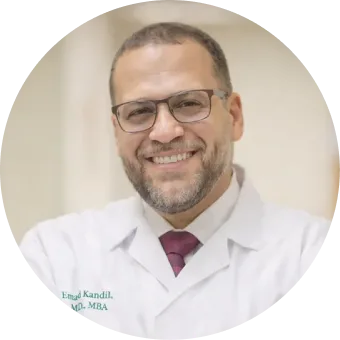
Ablation shrinks thyroid nodules using local anesthesia only, with no neck incision. Dr. Emad Kandil has performed more than 2,000 ablation cases. We match the method to each nodule’s characteristics:
nsPFA ablation, a non-thermal option
Ethanol ablation for fluid-filled cysts
Using ultrasound guidance, the treatment is delivered directly into the nodule. Over the following months, the body gradually absorbs the treated tissue and the nodule shrinks.
Ablation targets only the abnormal tissue and preserves the rest of the gland. Patients often expect the same outcome they would have after surgery, but preserving the gland changes that answer.
Because the surrounding healthy tissue keeps working, most patients who had normal thyroid function before ablation continue to have normal thyroid function afterward. They do not need to start thyroid hormone because of the procedure.
Total thyroidectomy: The whole gland is removed, so daily thyroid hormone is needed for life.
Partial thyroidectomy (lobectomy): Half the gland is removed, and some patients need thyroid hormone afterward.
Thyroid ablation: The gland stays in place, and most patients do not need new medication.
Medication needs depend on nodule type, nodule size and existing thyroid function. A few situations are worth knowing about:
You already take thyroid hormone. If you have an underactive thyroid, such as from Hashimoto’s thyroiditis, you will likely continue your current medication. Ablation does not cause that need, and it does not cure it.
You have an overactive nodule. Some patients with an overactive, or toxic, nodule take medication to control hormone levels before treatment. Once the nodule is fully ablated, many can reduce or stop that medication.
Your thyroid function changes over time. Thyroid function can shift with age or other health conditions, regardless of ablation. Routine testing helps catch any changes early.
An overactive nodule produces extra thyroid hormone on its own, which can cause symptoms like a rapid heartbeat, anxiety, weight changes or trouble sleeping. Medication can help manage these symptoms, but it does not remove the nodule.
Ablation treats the source of the extra hormone. As the treated nodule shrinks and stops overproducing, hormone levels often return to normal. We monitor your blood work closely and let you know when it is safe to adjust or stop your medication. Never stop a prescribed medication on your own.
Ablation is an outpatient procedure, so you go home the same day. Most patients return to their normal routines quickly. Some mild tenderness or swelling in the neck is common and usually fades on its own.
Because there is no incision, there is no surgical scar to heal. Your care team will review any activity guidelines and next steps with you before you leave.
Blood tests after ablation confirm that hormone levels stay normal. If a patient does need thyroid hormone, we adjust the dose over time based on these results.
Follow-up ultrasound imaging also lets us track how much the nodule has shrunk and confirm that treatment is working. These visits give you a chance to ask questions and share any changes in how you feel.
Is my nodule a good fit for ablation?
Which ablation method do you recommend for me, and why?
How will my current thyroid medication be affected?
How often will I need blood tests and ultrasounds afterward?
What results can I expect, and over what timeframe?
For most patients, lifelong medication is not needed after thyroid ablation. Ablation preserves the gland, and follow-up testing confirms that it keeps working. Patients who already take thyroid hormone usually continue it, and patients with overactive nodules may be able to reduce or stop their medication after treatment.
If you are exploring options for thyroid nodules, Kandil Thyroid and Parathyroid Institute can help you understand whether ablation is right for you. We see patients in Metairie, Louisiana, and Jersey City, New Jersey, and many patients travel to us for ablation. Call (504) 822-6709 to schedule your consultation.
About the Author
Dr. Emad kandil
October 12, 2026