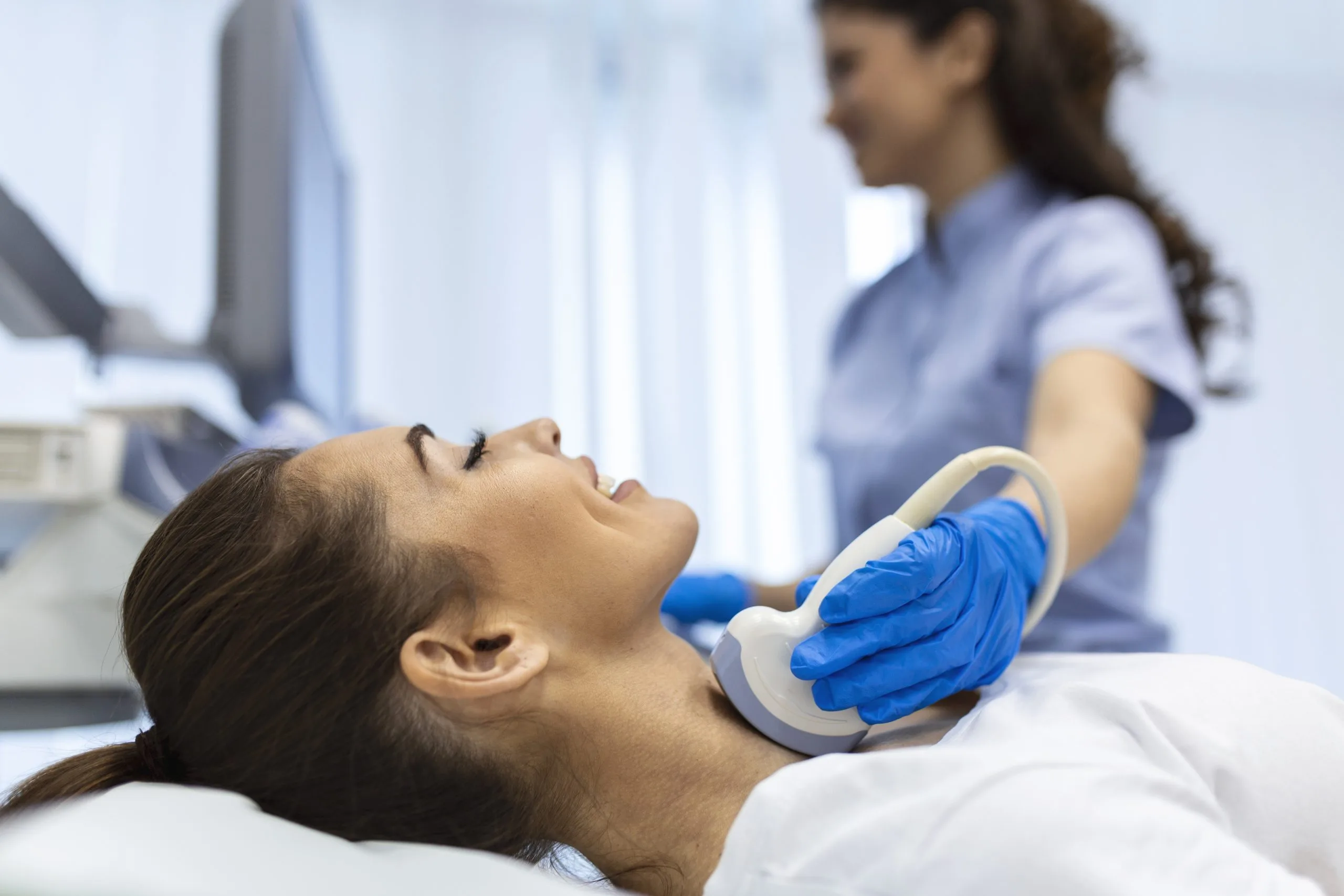
The main difference between parathyroid ablation and surgery is that ablation is a minimally invasive, needle-based procedure performed without incisions or general anesthesia, while surgery physically removes the overactive gland through a small neck incision. Both treatments aim to correct hyperparathyroidism by normalizing elevated calcium and parathyroid hormone (PTH) levels. The right choice depends on your health profile, anatomy, the number of overactive glands, and your preferences regarding recovery and scarring.
Parathyroid ablation is a non-surgical technique that treats primary hyperparathyroidism by delivering targeted energy or a chemical agent directly into an overactive parathyroid gland. Rather than removing the gland entirely, ablation destroys the malfunctioning tissue while leaving the surrounding structures intact. The procedure is guided by real-time imaging, which allows Dr. Emad Kandil to visualize the gland throughout treatment and ensure precise targeting.
Our team utilizes advanced technologies, including radiofrequency ablation (RFA) and microwave ablation (MWA). In some cases, ethanol ablation may also be used. Each modality works through a slightly different mechanism, but all share the same goal: disabling the overactive gland without a surgical incision.
During a parathyroid ablation session, a thin needle or probe is guided through the skin of the neck under ultrasound or other advanced imaging. The procedure follows a precise sequence:
Precision Imaging: Dr. Kandil uses state-of-the-art imaging to precisely locate the overactive gland and map the safest path for the probe, avoiding critical structures, such as nerves and blood vessels.
Energy Delivery: Once the probe tip is positioned within the overactive gland, controlled thermal energy (radiofrequency or microwave) or chemical destruction with ethanol is applied. This heats or destroys the cells of the adenoma, causing them to break down and become inactive.
Hormone Regulation: As the treated tissue is absorbed by the body over the following weeks, the gland stops overproducing PTH. This allows blood calcium levels to return to normal, resolving the symptoms of hyperparathyroidism.
The entire treatment is performed on an outpatient basis under local anesthesia. Patients remain awake but comfortable, with the treatment area completely numb. Most are discharged the same day.
No incision and no visible scar. The probe enters through a tiny puncture site that heals without a trace, preserving the neck’s cosmetic appearance.
No general anesthesia. Local anesthesia makes ablation a safer option for many individuals, especially older patients or those with other health conditions.
Same-day discharge. Patients go home the same day rather than staying overnight, avoiding a hospital stay.
Rapid recovery. Most people resume daily routines within 24 to 48 hours.
High success rate. In properly selected candidates, parathyroid ablation is highly effective at curing primary hyperparathyroidism by normalizing PTH and calcium levels.
Not every patient with hyperparathyroidism is a candidate for ablation. A thorough evaluation, including imaging and blood work, is necessary to determine candidacy. Ideal candidates typically include:
Patients with a single, clearly identified adenoma. Ablation works when one specific overactive gland can be precisely located and visualized with ultrasound.
Patients who wish to avoid surgery. Some people prefer a non-surgical approach due to personal preference, concerns about scarring, or anxiety about general anesthesia.
Patients with recurrent or persistent hyperparathyroidism. If a previous surgery was unsuccessful or the condition returns, ablation can treat the problematic gland without the complexities of a second operation in scar tissue.
Patients with prior neck surgery. Previous thyroid or parathyroid surgery may increase surgical complexity from scar tissue, making ablation an attractive alternative.
Dr. Kandil evaluates each patient individually, using imaging studies and lab work to determine whether ablation, surgery, or another approach is the most appropriate course of action.
Parathyroid surgery is the traditional and most common treatment for primary hyperparathyroidism. It involves physically removing one or more overactive parathyroid glands through an incision in the neck. For decades, surgery has been the gold-standard treatment, and it remains the most widely studied and commonly performed option worldwide.
A parathyroid surgery is performed under general anesthesia in an operating room. The surgeon makes a small incision in the lower neck, carefully placed in a natural skin crease to be as discreet as possible. The surgeon then identifies the enlarged, overactive gland (adenoma) and removes it. In some cases, more than one gland may be overactive, and the surgeon will remove all diseased glands.
Modern surgical techniques are considerably less invasive than in previous decades. Focused parathyroid surgery targets only the affected gland rather than exploring all four parathyroid glands. Intraoperative PTH monitoring – where blood is drawn during the procedure to confirm that hormone levels drop – helps verify that the correct gland was removed and that all sources of overproduction have been eliminated before the surgery ends.
At Kandil Thyroid and Parathyroid Ablation Institute, parathyroid surgery is performed using precise techniques designed to minimize tissue disruption and help patients return to their daily routines quickly.
High cure rate. Parathyroid surgery has a well-documented success rate exceeding 95% in experienced centers, making it one of the most reliable treatments in endocrine surgery.
Treats multi-gland disease. When more than one parathyroid gland is overactive, surgery allows the surgeon to visually inspect all four parathyroid glands and address multiple glands in a single procedure.
Provides definitive diagnosis. The removed gland is sent to a lab for pathological analysis, providing definitive confirmation of the diagnosis (e.g., adenoma vs. hyperplasia or, in very rare cases, parathyroid cancer).
Immediate results. Once the overactive gland is removed, PTH levels drop almost instantly, and the body begins rebalancing its calcium levels.
Decades of long-term data. The outcomes and durability of parathyroid surgery have been tracked for many years, giving patients and physicians a high degree of confidence in long-term results.
Parathyroid surgery is the recommended treatment for many patients diagnosed with symptomatic primary hyperparathyroidism. It is particularly indicated for:
Patients with symptoms. Individuals experiencing fatigue, bone pain, kidney stones, or cognitive issues (“brain fog”) are strong candidates.
Patients with multi-gland disease. When pre-operative imaging suggests that more than one parathyroid gland is overactive, surgery is often the preferred approach.
Cases where an adenoma cannot be localized. If imaging tests fail to identify the location of the overactive gland, an experienced surgeon can explore the neck and locate it visually.
Patients with very high calcium levels.
Concern for parathyroid cancer. Although rare, parathyroid cancer requires surgical excision for proper diagnosis and treatment.
Patient preference. Some individuals prefer the definitive, well-established approach of gland removal.
Understanding the practical differences between these two treatments helps patients make an informed decision.
For patients who prioritize minimal downtime and no visible scarring, ablation offers clear advantages. Surgery, while requiring a longer recovery window, provides the reassurance of direct gland removal and pathological confirmation.
Both ablation and surgery have demonstrated strong effectiveness in normalizing calcium and PTH levels. The choice between them does not typically mean choosing a “lesser” treatment – rather, it means selecting the approach that matches a patient’s clinical and personal needs.
Surgery is the definitive “gold standard” with a cure rate of over 95%. Its main advantage is the ability to visually inspect and remove all diseased glands, making it highly effective for multi-gland disease.
Ablation also boasts a high success rate for treating single, well-localized adenomas. The cure is not instantaneous – it takes several weeks for the ablated tissue to fully stop producing PTH and for calcium levels to normalize. However, for carefully selected patients, its effectiveness is comparable to surgery for single-gland disease.
After successful treatment with either method, patients can expect:
PTH levels to drop significantly – often within minutes after surgery, or over days to weeks after ablation.
Serum calcium to normalize, relieving symptoms such as fatigue, bone pain, kidney stones, and cognitive fog.
Phosphorus levels may improve as the calcium-phosphorus balance is restored.
Ablation produces a more gradual biochemical response because the treated gland shrinks over time rather than being immediately removed. Surgery produces an immediate drop in PTH that is measurable during the operation itself. Both approaches ultimately aim for sustained normalization of mineral metabolism.
This occurs when an overactive gland is missed or when a new one becomes overactive later. In surgery, it may happen if an adenoma is in an unusual location. In ablation, it can occur if the adenoma is not fully neutralized or if there is an undiagnosed second adenoma.
After treatment, calcium levels can sometimes drop too low – a condition called hypocalcemia. This is usually temporary as the remaining healthy parathyroid glands “wake up” and resume normal function. It can cause symptoms like tingling or muscle cramps and is managed with calcium and vitamin D supplements.
The recurrent laryngeal nerve, which controls the vocal cords, runs very close to the parathyroid glands. Injury to this nerve can cause temporary or permanent hoarseness. However, the precision of ultrasound-guided parathyroid ablation allows the provider to visualize the nerve and surrounding structures in real time, helping to avoid the nerve.
A growing body of published research supports parathyroid ablation as a viable alternative to surgery for selected patients. Key findings from recent meta-analyses and clinical studies include:
Cure rates for thermal ablation (RFA and MWA) in single-gland primary hyperparathyroidism have been reported to range from 80–95%, approaching the cure rates achieved by surgery.
Symptom improvement, including reductions in fatigue, bone pain, and kidney stone formation, has been documented in both surgical and ablation cohorts.
Recurrence rates after ablation may be slightly higher than after surgery in some studies, underscoring the importance of careful patient selection and follow-up.
Patient satisfaction scores for ablation are consistently high, driven by the absence of scarring, shorter recovery, and avoidance of general anesthesia.
Surgery remains the standard for patients with suspected multi-gland disease, very large adenomas, ectopic glands, or when the adenoma cannot be localized with imaging.
Ablation for hyperparathyroidism is newer than surgery, and long-term data beyond 5–10 years is still accumulating. As ablation experience grows globally, the evidence base continues to strengthen. The evidence confirms that ablation is not just a niche procedure but a mainstream option for the right patient profile.
Both ablation and surgery are effective treatments for hyperparathyroidism, and each has distinct advantages depending on the patient’s clinical picture. Ablation offers a scarless, outpatient experience under local anesthesia with rapid recovery, making it particularly appealing for patients with single-gland disease, older adults, or those who want to avoid general anesthesia. Surgery provides the longest track record, the ability to address multi-gland disease, and the certainty of tissue removal with pathological confirmation.
The most important step is an individualized evaluation by a physician who offers both options. Dr. Emad Kandil and his team specialize in exactly this kind of patient-centered approach, ensuring that every patient receives the treatment most likely to restore their health and quality of life.
About the Author
Dr. Emad kandil
June 16, 2026